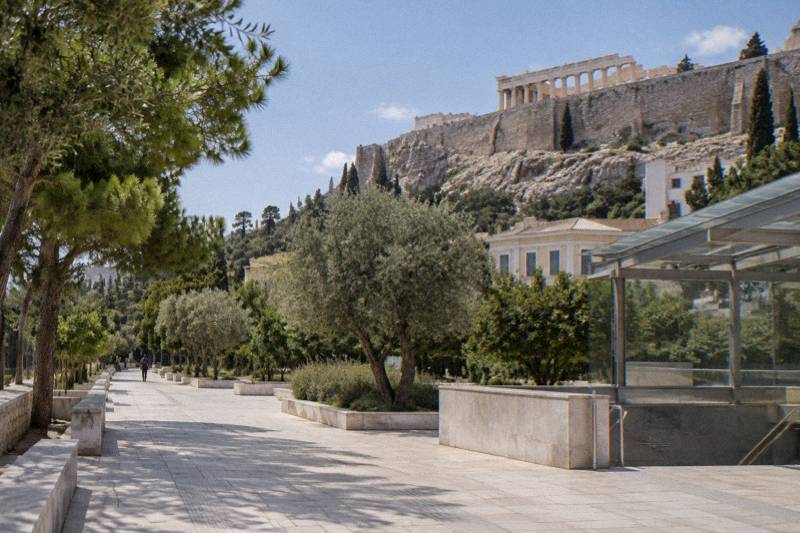
Is The Acropolis Museum Ever Free?
The Acropolis Museum is free on four dates a year: 6 March, 25 March, 18 May and 28 October. Here is what a normal ticket costs, why there is no free Sunday, and what is free outside.

Is The Acropolis Museum Ever Free?
Yes, on four dates a year. The Acropolis Museum is free for everyone on 6 March, 25 March, 18 May and 28 October. On every other day of the year it is ticketed, at EUR 20 for a general ticket and EUR 10 reduced, and it takes part in no monthly free Sunday scheme of any kind. Free and reduced tickets are issued only at the museum ticket desk, with documents, never online.
That is the short answer, and the four dates are the whole of it. What trips the question up is that the museum sits at the foot of the Acropolis, and people assume the two share one ticketing system. They do not. The Acropolis is a Ministry of Culture state archaeological site, ticketed at EUR 30 full and EUR 15 reduced, free only on the Ministry's own free dates. The Acropolis Museum is an independent museum with its own prices, its own free days and its own rules about how those free days work. The museum's own site, theacropolismuseum.gr, states the four dates and the desk rule; it is the authority on both.
The distinction matters in one direction in particular. The Ministry's free dates are 6 March, 18 April, 18 May, the last weekend of September and 28 October, and they apply to the state sites: the Acropolis itself, the Ancient Agora, the Roman Agora and the Tower of the Winds, Hadrian's Library, the Temple of Olympian Zeus, Kerameikos and the Lykeion. The museum's list is shorter and different: 6 March, 25 March, 18 May and 28 October. Two of those dates, 6 March and 18 May, coincide with the Ministry's. Two do not. The museum has no free day in the last weekend of September and no free day on 18 April, and it does add 25 March, which the Ministry's list does not carry.
There is a further condition that is easy to miss in the excitement of a free date. Even on the four free days, the tickets are physical and they are collected at the museum ticket desk. There is no online free ticket to book in advance, and there is no printed voucher to show at the door. The same desk rule covers the reduced EUR 10 ticket and the free categories on ordinary days: documents are checked, and the desk is the only place the transaction happens. The museum's own pages state this, and it is the single most practical thing to know about the four dates before anyone builds a day around them.
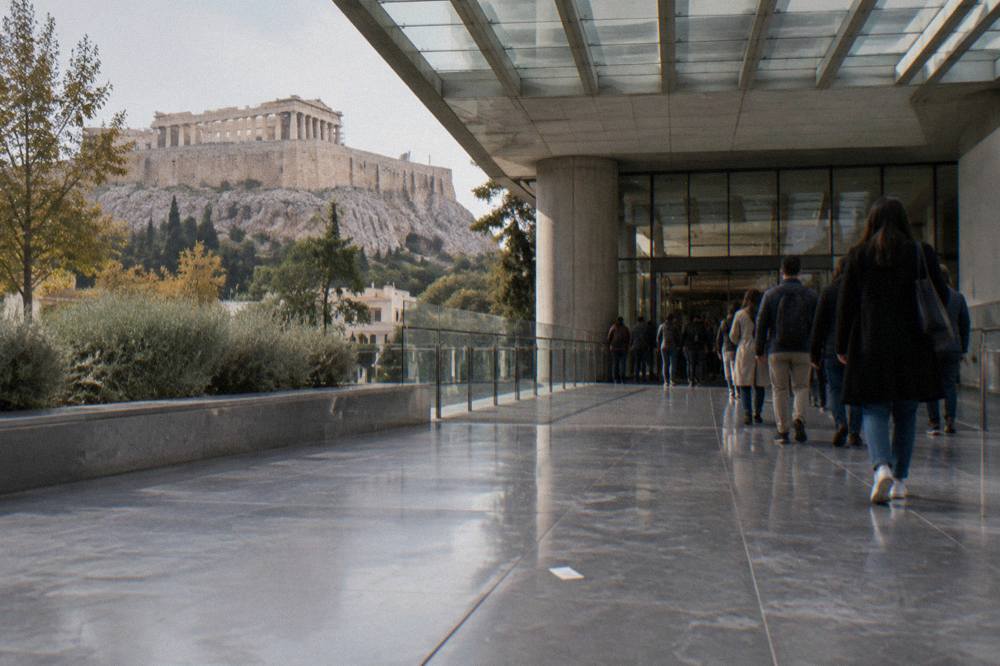
For visitors who want the museum and the ancient city together rather than the museum alone, a free walking tour adds context, and Free Things To Do In Athens lists 18 free walking tours across GuruWalk and freetour.com, every one of them free or pay what you want.
Which Four Dates Are Free?
The four free dates are 6 March, 25 March, 18 May and 28 October, and on those days the museum is free for everyone, not just for the usual free categories. The tickets are still collected at the museum ticket desk with documents. There is no online booking for a free day, and the museum states plainly that it runs no monthly free Sunday on top of these four dates.
Here are the dates, one by one, with what each one is.
| Date | Who it applies to | How the ticket works |
|---|---|---|
| 6 March | Everyone | Collected at the museum ticket desk with documents |
| 25 March | Everyone | Collected at the museum ticket desk with documents |
| 18 May | Everyone | Collected at the museum ticket desk with documents |
| 28 October | Everyone | Collected at the museum ticket desk with documents |
The desk rule deserves its own sentence, because it is the part of the arrangement that costs people their free day. On all four dates, free entry means standing in the ticket line and being issued a ticket at the desk. The museum does not offer a free ticket that can be reserved ahead, and it does not accept a phone screen in place of a paper ticket for the free categories. The same rule applies on ordinary days to the reduced EUR 10 ticket and to the free categories that qualify on the basis of age or status: documents are checked at the desk, and the desk is where the ticket is issued.
Two of the four dates carry meaning beyond the museum's own calendar. 25 March is Greek Independence Day, and 28 October is Ohi Day. The museum's list is its own, stated on its own site, and it does not borrow or lend dates to the state archaeological sites. 6 March and 18 May are the two dates the museum and the Ministry's sites share, so those are the days a visitor can walk a state site in the morning and the museum in the afternoon without a ticket at either. On 18 April and the last weekend of September the state sites are free and the museum is not, and on 25 March the museum is free while the Acropolis is closed for the day.
Planning around the four dates is simple arithmetic from there. A general ticket is EUR 20, so a free date saves that amount per person. A family of four on 18 May saves EUR 80 against the general price, less any members who qualify for the reduced ticket or a free category on ordinary days anyway. Against that saving stands the one condition the museum attaches: the desk, the documents and the queue, on a day when everyone else in Athens has read the same four dates.
What Does A Normal Ticket Cost?
A general ticket costs EUR 20 and a reduced ticket costs EUR 10, and the ticket includes the excavation beneath the museum. On the four free dates the price drops to nothing for everyone. On all other days the reduced ticket and the free categories are issued only at the museum ticket desk with documents, and the museum states no other discount route.
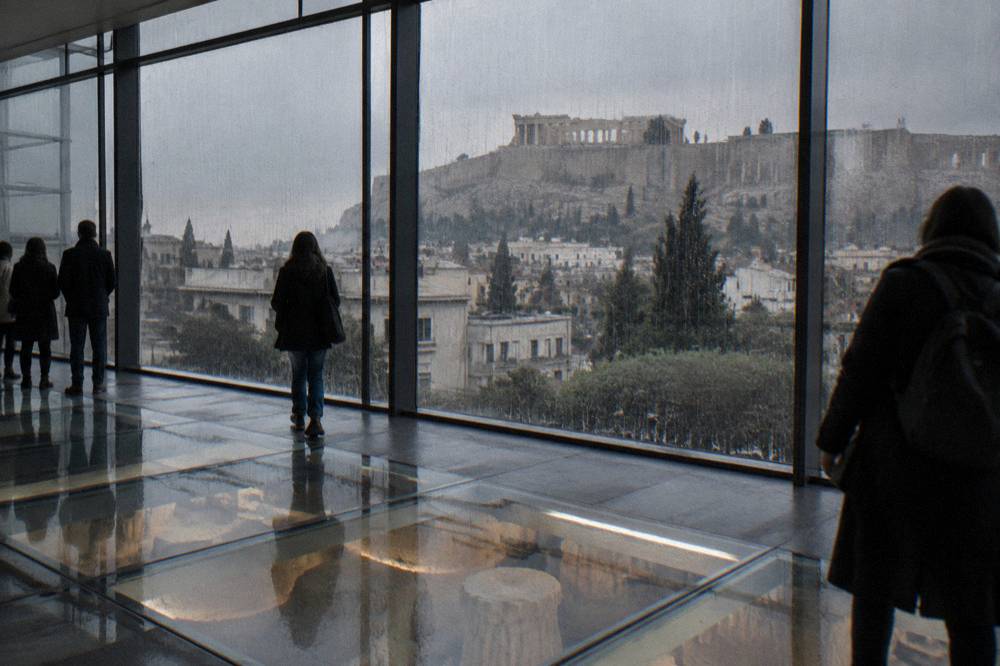
The prices are fixed and published. EUR 20 buys the general ticket, EUR 10 the reduced one, and both include the excavation that sits underneath the building, visible through the museum's floors and entered as part of the visit. The excavation is not a separate add-on and cannot be bought apart from the museum ticket, which makes the EUR 20 a single price for two things: the galleries above and the ancient streets below.
| Ticket | Price | What it covers | Where it is issued |
|---|---|---|---|
| General | EUR 20 | Galleries and the excavation beneath the museum | Museum ticket desk |
| Reduced | EUR 10 | Galleries and the excavation beneath the museum | Museum ticket desk, with documents |
| Free day ticket | EUR 0 | Same as general, on 6 March, 25 March, 18 May, 28 October | Museum ticket desk, with documents |
The opening hours follow the seasons, and the museum's own pages set them out. In winter, from 1 November to 31 March, the museum opens Monday to Thursday from 09:00 to 17:00, Friday from 09:00 to 22:00, and Saturday and Sunday from 09:00 to 20:00. In summer, from 1 April to 31 October, it opens Monday from 09:00 to 17:00, Tuesday to Sunday from 09:00 to 20:00, with Friday running to 22:00. It closes on 1 January, Orthodox Easter Sunday, 1 May, and 25 and 26 December.
| Season | Days | Hours |
|---|---|---|
| Winter, 1 Nov to 31 Mar | Monday to Thursday | 09:00 to 17:00 |
| Winter, 1 Nov to 31 Mar | Friday | 09:00 to 22:00 |
| Winter, 1 Nov to 31 Mar | Saturday and Sunday | 09:00 to 20:00 |
| Summer, 1 Apr to 31 Oct | Monday | 09:00 to 17:00 |
| Summer, 1 Apr to 31 Oct | Tuesday to Sunday | 09:00 to 20:00 |
| Summer, 1 Apr to 31 Oct | Friday | 09:00 to 22:00 |
Two of the four free dates therefore fall inside the winter season and two inside the summer season, which changes the shape of the day around them. On free dates such as 6 March and 28 October, the opening hours are the ones the museum's own pages give for that day, and the same holds for the other dates on its free list. Hours for each free date are on the museum's own pages. The museum's own pages are the authority on the hours, and the dates above are copied from them.
One comparison is worth making before anyone budgets the museum into a trip. The Acropolis site itself costs EUR 30 full and EUR 15 reduced, and one ticket covers the Acropolis and its Slopes, used once. The museum at EUR 20 is the cheaper of the two, and on its four free dates it is the only one of the pair that costs nothing. The two are separate operators with separate tickets, and no ticket for one grants anything at the other. Visitors weighing both against a single day's budget can read the fuller breakdown in the site's Acropolis Museum guide and the explainer Is the Acropolis free.
Is There A Free Sunday?
No. The Acropolis Museum states on its own pages that it runs no monthly free Sunday, and it is not part of the winter Sunday arrangements that some state-run museums apply. Its free entry is the four dates and the standing free categories, and nothing else. Any claim of a free first Sunday at this museum is wrong.
This is the point where Athens trips over itself, and it is worth being precise about why. Several museums in the city do run Sunday free days in the winter months, and each one states its own rule on its own page. The Byzantine and Christian Museum applies a first-and-third-Sunday rule from 1 November to 31 March. The National Gallery applies a first-Sunday rule over the same winter window. The National Historical Museum applies a first-Sunday rule from November to February only. EMST opens free on the first Thursday evening of the month instead, and says so itself. These are separate operators with separate rules, and none of them transfers to any other museum.
The Acropolis Museum stands apart from all of it. Its own site lists the four dates and states that there is no monthly free Sunday, and it is not a Ministry of Culture site, so the winter arrangements that apply to state museums and state archaeological sites were never its scheme to join. The practical consequence is that a Sunday visit in, say, February costs EUR 20 exactly the same as a Tuesday visit, and the only free Sundays in the museum's year are the ones that happen to land on 6 March, 25 March, 18 May or 28 October, when the free day applies to everyone regardless of the weekday.
The separate question, whether the state archaeological sites run a winter Sunday scheme, is one this site answers for the sites themselves rather than for the museum, and the what day is the Acropolis free page covers it. What can be said here is narrow and firm: whatever any other Athens museum does on Sundays, the Acropolis Museum does not do it, and its four dates are the complete list.
What Is Free Outside The Museum?
The Dionysiou Areopagitou promenade is free to walk, and it runs along the Acropolis south slope as a pedestrian street. The monuments beside it, the Acropolis, the Theatre of Dionysus, the Acropolis Museum and the Olympieion, are each separately ticketed. The promenade itself costs nothing to walk.
The promenade is the free spine of the whole Acropolis quarter, and it is the honest answer to the question every EUR 20 ticket eventually prompts. It is a pedestrian street, free to walk, and the ticketed monuments sit beside it as separate entries: the Acropolis at EUR 30 full and EUR 15 reduced on its own Ministry of Culture page, the museum at EUR 20, the Olympieion at EUR 20 full and EUR 10 reduced under the same Ministry regime. Walking the promenade grants entry to none of them. It costs nothing in itself, and it is the one piece of ground in the quarter where that sentence needs no condition attached.
The free ground around the Acropolis extends further than the promenade. Philopappos Hill and the Pnyx, the Western Hills of the Acropolis, are listed at EUR 0 and open 24 hours, with wildfire-season closure notices possible. The National Garden is free from sunrise to sunset. Monastiraki Square, the streets of Plaka and Anafiotika and the squares of the old town are open public space. The pattern across the quarter is consistent: the hills, the promenade and the streets are free, and the fenced archaeological sites and the museums are ticketed, each under its own operator and its own price list.

For the museum visitor, the useful framing is two facts held side by side rather than one blurred into the other. The Acropolis Museum is EUR 20 on every day except its four free dates, and the promenade outside its door is free to walk. The site's free museums in Athens guide carries the same two-fact discipline across the city's other museums, each with its own dates and its own desk rules.
Which Free Walking Tours Meet Near The Acropolis Museum?
The free walking tours that meet near the Acropolis Museum are among the 18 pay-what-you-want walks listed on this site across GuruWalk and freetour.com, several of which use the Acropolis Museum area as their starting point or pass through it during the route. None of these tours charges a booking fee, so you simply reserve your spot online and pay your guide whatever you think the walk deserved at the end.
Each is introduced by its platform, its guide or operator, its rating with its scale, its review count, its duration, its languages and its meeting point, which is all any listing can honestly promise before a reader clicks through.
History Enthusiasts' 3-Hour Walk is a freetour.com listing run by Athens Historic Experiences, rated 9.8 out of 10 across 114 freetour.com reviews. It runs in English for 3 hours and meets at Panepistimio Metro Station.
Become Greek On Foot, 3 Hours is a GuruWalk listing run by Become Greek on foot, rated 4.77 out of 5 across 3,292 GuruWalk reviews. It runs in English, Spanish and Italian for 3 hours and meets at Epimenidou Street in Plaka.
The 3-Hour Historic Center Walk is a GuruWalk listing run by Elena, rated 4.56 out of 5 across 2,281 GuruWalk reviews, in English and Spanish for 3 hours, meeting at Acropolis Metro Station. Trilingual Best-Of Walk is a freetour.com listing run by Atenas en Español F.T., rated 9.2 out of 10 across 99 freetour.com reviews, in English, French and Spanish for 2 hours 30 minutes, meeting at Athens Metropolitan Cathedral. Multilingual Mythology, Acropolis View is a GuruWalk listing run by Scandic Tours, rated 4.6 out of 5 across 175 GuruWalk reviews, in German, English, Spanish, French and Italian for 2 hours, meeting at Syntagma Square.
| Walk | Platform | Rating and reviews | Duration | Languages | Meeting point |
|---|---|---|---|---|---|
| History Enthusiasts' 3-Hour Walk | freetour.com | 9.8 out of 10 across 114 freetour.com reviews | 3 hours | English | Panepistimio Metro Station |
| Become Greek On Foot, 3 Hours | GuruWalk | 4.77 out of 5 across 3,292 GuruWalk reviews | 3 hours | English, Spanish, Italian | Epimenidou Street |
| 3-Hour Historic Center Walk | GuruWalk | 4.56 out of 5 across 2,281 GuruWalk reviews | 3 hours | English, Spanish | Acropolis Metro Station |
| Trilingual Best-Of Walk | freetour.com | 9.2 out of 10 across 99 freetour.com reviews | 2 hours 30 minutes | English, French, Spanish | Athens Metropolitan Cathedral |
| Multilingual Mythology, Acropolis View | GuruWalk | 4.6 out of 5 across 175 GuruWalk reviews | 2 hours | German, English, Spanish, French, Italian | Syntagma Square |
The pay-what-you-want model is the same on both platforms, and it is the reason these walks belong on a page about free things. A walker pays nothing up front, joins at the stated meeting point, and tips the guide at the end at whatever amount the walker chooses. No Athens walk on this site's roster declares a required cost, a deposit or a paid add-on, and no listing carries a price tag in the booking flow. The full picture of how the model works, and what a tip runs, is set out in how much to tip on a free walking tour in Athens.
Three more English-language walks round out the central roster, each on its own ground. Heart Of The City Walk is a GuruWalk listing run by William, rated 4.91 out of 5 across 164 GuruWalk reviews, in English for 2 hours 15 minutes, meeting at Mitropoleos and Voulis Streets. Hidden Corners, Myths And Local Life is a freetour.com listing run by Ektor free walking tour, rated 9.7 out of 10 across 1,550 freetour.com reviews, in English for 2 hours 30 minutes, meeting at the Lord Byron Statue. Local Walk With A Furry Pal is a GuruWalk listing run by Alexia, rated 4.88 out of 5 across 358 GuruWalk reviews, in English for 2 hours, meeting at the Panathenaic Stadium.
Common Questions On This Topic
Is The Acropolis Museum Ever Free?
Yes, on four dates a year: 6 March, 25 March, 18 May and 28 October. On those days entry is free for everyone, with tickets collected at the museum ticket desk and documents. On every other day the museum is ticketed at EUR 20 general and EUR 10 reduced.
Which day is the Acropolis Museum free?
The museum's free days are fixed calendar dates, not weekdays: 6 March, 25 March, 18 May and 28 October. There is no monthly free Sunday and no recurring free weekday, so the only way to catch a free day is to be in Athens on one of those four dates.
How much does the Acropolis Museum cost?
A general ticket costs EUR 20 and a reduced ticket costs EUR 10, and both include the excavation beneath the museum. Reduced and free-category tickets are issued only at the museum ticket desk with documents, not online.
Is the Acropolis Museum free on Sundays?
No. The museum states on its own pages that it runs no monthly free Sunday, and it is not part of the winter Sunday arrangements that some state-run museums apply. Its free entry is the four dates and the standing free categories, and nothing else.
Can you book a free ticket for the Acropolis Museum online?
No. Free and reduced tickets are issued only at the museum ticket desk, with documents. On the four free dates the same desk rule applies, so a free day still means the ticket line.
Is the Acropolis Museum free on the same days as the Acropolis?
Only on two of the four dates. The museum is free on 6 March, 25 March, 18 May and 28 October. The Ministry of Culture's state sites, including the Acropolis, are free on 6 March, 18 April, 18 May, the last weekend of September and 28 October. The two lists share 6 March and 18 May and differ on the rest.