Ancient Agora Of Athens: Ticket Prices, Free Dates And What Costs Nothing Nearby
The Ancient Agora of Athens is a ticketed state archaeological site: EUR 20 full, EUR 10 reduced, one ticket for the site and its museum. Free entry lands on five fixed dates a year, and the ground around the site, from the Areopagus rock to Monastiraki Square, costs nothing at all.
Short answer
The Ancient Agora of Athens is ticketed every day: EUR 20 for a full ticket, EUR 10 reduced, and the single ticket covers the site and the Museum of the Ancient Agora in the Stoa of Attalos. Entry is free only on 6 March, 18 April, 18 May, the last weekend of September and 28 October. The Areopagus rock and Monastiraki Square beside it are free.
The Ancient Agora of Athens is one of the city's ticketed state archaeological sites, and the practical questions around it are simple ones: what does entry cost, when does that cost drop to zero, and what can be seen without a ticket at all? This guide answers all three with the operator's own figures. The Free Things To Do In Athens guides cover what the city charges for and what it does not.
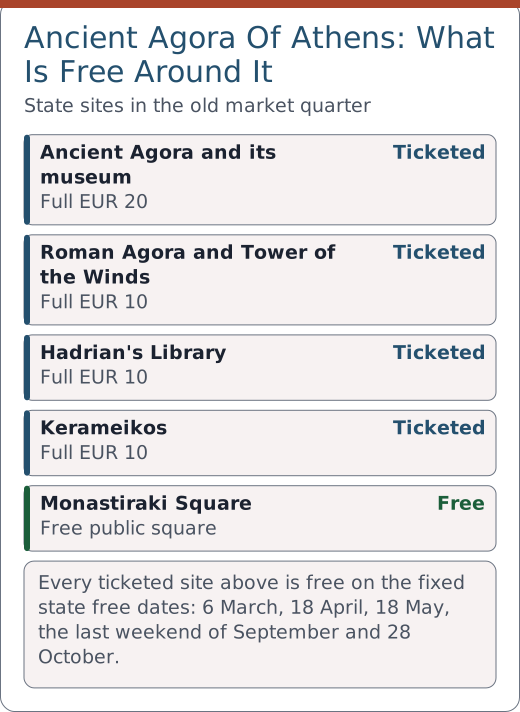
Two facts travel together through everything below. The Ancient Agora itself is ticketed, at EUR 20 full and EUR 10 reduced, and that single ticket is valid for both the archaeological site and the Museum of the Ancient Agora in the Stoa of Attalos. Free entry applies on five fixed dates each year and on no others. Around the ticketed ground, the picture changes: the Areopagus rock is free, Monastiraki Square is free, and the Tower of the Winds can be seen from public streets without a Roman Agora ticket.
Is The Ancient Agora Free?
No. The Ancient Agora of Athens is ticketed every day: EUR 20 for a full ticket, EUR 10 reduced, and the single ticket covers the archaeological site and the Museum of the Ancient Agora in the Stoa of Attalos. Entry is free only on the five Ministry of Culture dates: 6 March, 18 April, 18 May, the last weekend of September and 28 October. The Areopagus rock beside it is a separate free place.
That is the whole shape of it, and the distinction matters because the Agora sits in a part of Athens where free and paid ground sit close together. The site is run by the Ministry of Culture as a state archaeological site, which puts it in the same entry regime as the Acropolis, the Roman Agora, Hadrian's Library, the Olympieion, Kerameikos and the Lykeion. All of them are ticketed every day, and all of them open their gates free of charge on the same five dates. The Ministry publishes those dates for each of its sites, and the Ancient Agora is on the Ministry's odysseus site with the rest.
What the ticket never becomes is a Sunday promise. The five dates are fixed calendar dates, and none of them is described by the operator as a recurring Sunday scheme.
The free categories are the other half of the answer. Like the other Ministry sites, the Ancient Agora admits certain visitors free on any opening day, and those categories are checked with ID at the entrance. The permanent free categories for Ministry sites are set out by the Ministry itself, and they travel with the visitor, not with the date: they apply on a Tuesday in February exactly as they do in August. What this means in practice is that "is the Agora free" has two honest answers, and the second one is the one people miss. For most visitors, no, it is EUR 20 or EUR 10. For the visitors in the Ministry's free categories, yes, every day of operation, with ID shown.
The neighbouring free ground is covered in full in its own section below, but the short version belongs here too, because the Agora's answer is never complete without it. The Areopagus, the rock also called Mars Hill, is a free public rock with views over the Agora and no ticket gate. Monastiraki Square is a free public square. Neither of those places inherits the Agora's ticket, and the Agora does not inherit their freedom. A hill, a square and a museum can each have a separate entry regime in Athens, and the Agora shows exactly how that works.
What Does Entry To The Ancient Agora Cost?
A full ticket costs EUR 20 and a reduced ticket costs EUR 10, and the same ticket is valid for the archaeological site and the Museum of the Ancient Agora (Stoa of Attalos) together. Winter opening is 08:00 to 16:30 with last entrance at 16:10. Summer opening is 08:00 to 19:30 with last entrance at 19:00.
The price structure is a flat two-tier one, with no time-of-day pricing and no separate museum ticket. That last point is worth slowing down on, because it is the Agora's one genuine built-in saving: the EUR 20 ticket is not a site-only ticket with a museum upsell attached. It covers the Museum of the Ancient Agora in the Stoa of Attalos as part of the same entry, so a visitor holding it does not face a second desk inside.
| Ticket | Price | What it covers |
|---|---|---|
| Full ticket | EUR 20 | The archaeological site and the Museum of the Ancient Agora (Stoa of Attalos) |
| Reduced ticket | EUR 10 | The same coverage: site and museum together |
| Winter opening | 08:00 to 16:30 | Last entrance 16:10 |
| Summer opening | 08:00 to 19:30 | Last entrance 19:00 |
The hours run on a winter and summer split, and the last-entrance times sit close enough to the closing times that they belong in any planning note. A visitor arriving at 16:00 on a winter day has ten minutes of entrance window left, not half an hour.
For anyone weighing the EUR 20 against the rest of a trip's budget, the honest comparison is with the other state sites in the same regime. The Acropolis is EUR 30 full and EUR 15 reduced. The Roman Agora is EUR 10 and EUR 5, and Hadrian's Library matches that at EUR 10 and EUR 5. The Agora therefore sits between the two: double the smaller sites, two-thirds of the Acropolis, with a museum included in the price that the Acropolis ticket does not carry. The Ministry's pages name tickets.hh.gr as their e-ticket service for visitors buying ahead.
For visitors who want the ancient core of the city explained rather than just walked past, there is a free way to do it. The walks below are pay-what-you-want tours run by independent local guides, booked at no charge, and this site lists 18 of them across GuruWalk and freetour.com.
On Which Dates Is The Ancient Agora Free?
Entry is free on five fixed dates each year: 6 March, 18 April, 18 May, the last weekend of September and 28 October. The same five dates apply to the Roman Agora and to Hadrian's Library. They do not apply to the Acropolis Museum, which keeps its own four dates, and they do not extend to private museums.
The five dates are the Ministry of Culture's free-admission days across its state archaeological sites, the Ancient Agora among them; each museum keeps its own rule. For the Agora, that means the EUR 20 and EUR 10 tickets are not sold on those dates, and the site and the museum in the Stoa of Attalos are both open free. The dates are calendar-fixed, so planning around them is straightforward arithmetic: 6 March, 18 April, 18 May, the last weekend of September and 28 October.
| Date | Ancient Agora | Roman Agora | Hadrian's Library |
|---|---|---|---|
| 6 March | Free entry | Free entry | Free entry |
| 18 April | Free entry | Free entry | Free entry |
| 18 May | Free entry | Free entry | Free entry |
| Last weekend of September | Free entry | Free entry | Free entry |
| 28 October | Free entry | Free entry | Free entry |
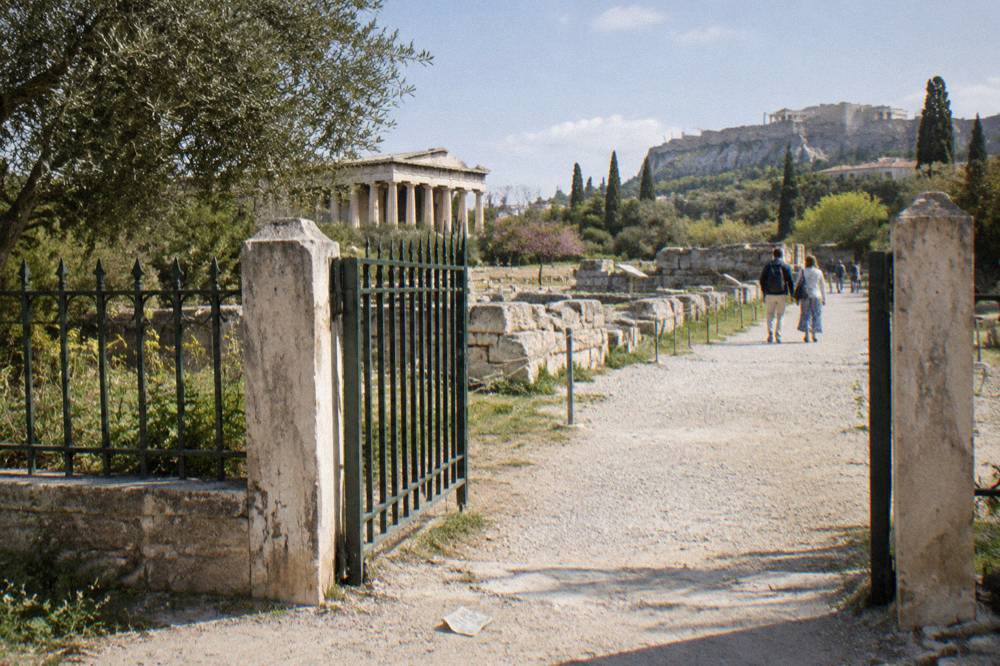
What the five dates are not is a portable rule. The Acropolis Museum is an independent museum, not a state site, and its own free dates are 6 March, 25 March, 18 May and 28 October, with a EUR 20 general ticket and free and reduced tickets collected at the museum desk. The National Historical Museum keeps its own list. The Panathenaic Stadium's page states its own free categories and a EUR 12 ticket. None of those operators borrows the Ministry's five dates, and the Agora's free days say nothing at all about any of them.
For visitors who want a guide's voice over the ancient heart of the city on any day of the year, not only the five free ones, the pay-what-you-want walks are the answer that costs nothing upfront.
Which Neighbouring Places Are Free?
The Areopagus rock is free, with no ticket gate, and it carries views over the Agora. Monastiraki Square is a free public square. The Tower of the Winds can be seen from the public streets around the Roman Agora's perimeter fence without a ticket. Hadrian's Library and the Roman Agora are neighbouring ticketed sites at EUR 10 and EUR 5.
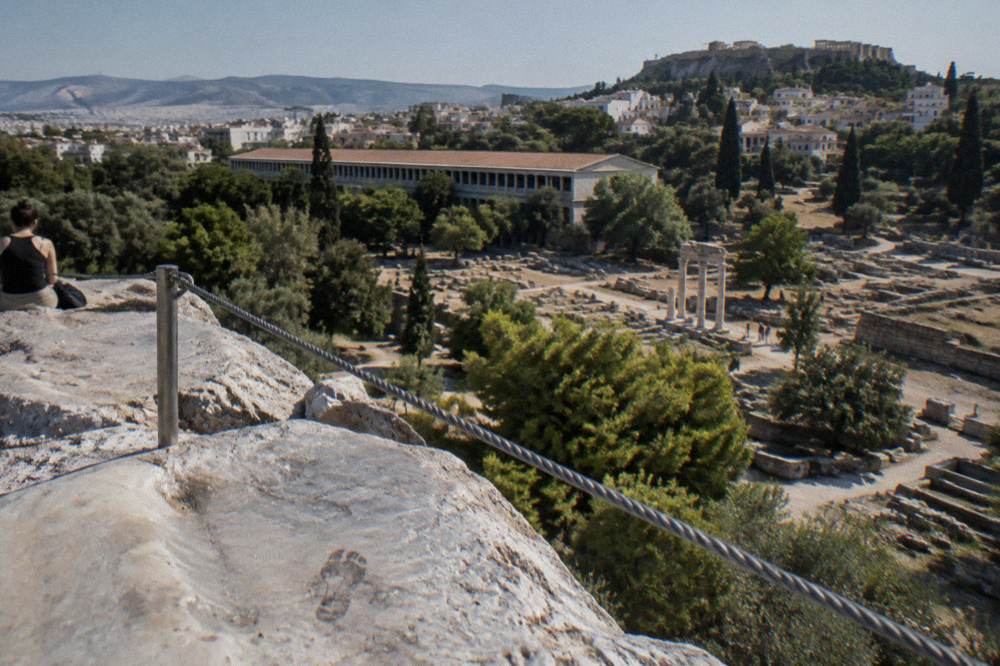
Every one of these places is its own operator's decision, so treat each one on its own terms. The Areopagus, also called Mars Hill, is a free public rock beside the Acropolis, and its views over the Agora cost nothing to stand in. Monastiraki Square is a free public square, full stop. Neither carries a condition, an ID check or a season. This site's Areopagus Hill free-access guide and its guide to what is free around Monastiraki Square cover both in detail.
| Place | Status | Price and condition |
|---|---|---|
| Areopagus (Mars Hill) | Free | Free public rock beside the Acropolis, with views over the Agora; no ticket gate |
| Monastiraki Square | Free | Free public square |
| Tower of the Winds from the street | Free | Seen from the public streets around the Roman Agora's perimeter fence: Aiolou, the Diogenous pedestrian street and Taxiarchon square |
| Hadrian's Library | Ticketed | EUR 10 full, EUR 5 reduced; free on the five Ministry dates |
| Roman Agora | Ticketed | EUR 10 full, EUR 5 reduced; free on the five Ministry dates |
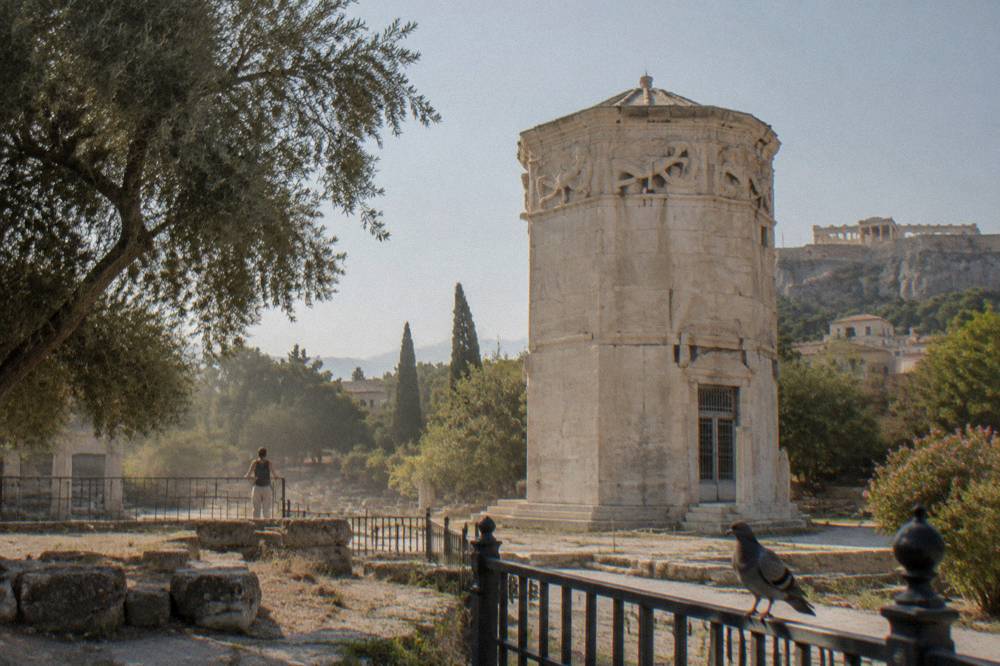
The Tower of the Winds deserves its own careful sentence, because it is the one place on this list where free and paid describe the same object from two sides. The tower stands inside the Roman Agora's perimeter, and walking inside the site costs EUR 10 full or EUR 5 reduced. But the tower can be seen from outside the fence, from the public streets around it, without a ticket. Both facts are true, and neither one cancels the other.
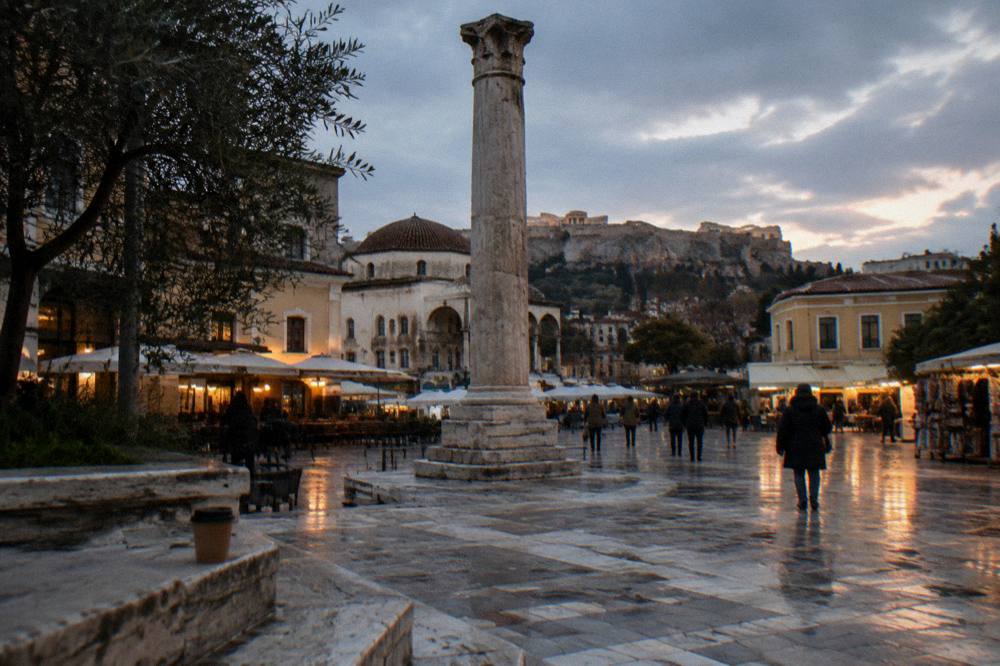
The same split runs through the whole neighbourhood. Hadrian's Library is ticketed at EUR 10 and EUR 5, free on the five Ministry dates, open 08:00 to 15:00 in winter and 08:00 to 20:00 in summer. Monastiraki Square, the free public square that sits in the middle of this cluster of ancient sites, is the budget anchor of the district: it costs nothing to be in, and everything ticketed around it is a separate, deliberate purchase.
How Does The Roman Agora Compare?
The Roman Agora is a separate ticketed site: EUR 10 full, EUR 5 reduced, open 08:00 to 15:00 in winter and 08:00 to 20:00 in summer. It shares the Ancient Agora's five free dates. Its Tower of the Winds can be seen free from the surrounding public streets, while walking inside the site needs the EUR 10 ticket.
The two agoras are separate sites with separate tickets, and mixing them up means arriving with the wrong ticket. The Ancient Agora is EUR 20 full and EUR 10 reduced, and its ticket includes the museum in the Stoa of Attalos. The Roman Agora is EUR 10 full and EUR 5 reduced, with no museum attached.
| Site | Full ticket | Reduced | Winter hours | Summer hours | Free dates |
|---|---|---|---|---|---|
| Ancient Agora of Athens | EUR 20 | EUR 10 | 08:00 to 16:30, last entrance 16:10 | 08:00 to 19:30, last entrance 19:00 | 6 March, 18 April, 18 May, last weekend of September, 28 October |
| Roman Agora | EUR 10 | EUR 5 | 08:00 to 15:00, last entrance 14:40 | 08:00 to 20:00, last entrance 19:30 | The same five dates |
| Hadrian's Library | EUR 10 | EUR 5 | 08:00 to 15:00 | 08:00 to 20:00 | The same five dates |
The hours differ as well as the prices, and the differences are not intuitive. The Roman Agora closes earlier than the Ancient Agora in winter, 15:00 against 16:30, but later in summer, 20:00 against 19:30. Last-entrance times sit twenty or thirty minutes before closing at both sites. The comparison table above is the one to plan from, because a late-afternoon itinerary that works at one of the two agoras can fail at the other on the same day.
The free dates, by contrast, are identical, because both sites answer to the same Ministry regime. On 6 March, 18 April, 18 May, the last weekend of September and 28 October, both agoras and Hadrian's Library open free. That makes those dates the only days on which the entire ancient cluster in this district, the Ancient Agora with its museum, the Roman Agora and Hadrian's Library, can be walked end to end for nothing. On every other day of the year, the honest budget for all three is EUR 40 full or EUR 20 reduced, and the honest budget for the free layer, the Areopagus, Monastiraki Square and the Tower of the Winds from the street, is zero.
Which Free Walking Tours Meet Near The Ancient Agora?
This site lists 18 free walking tours across GuruWalk and freetour.com, every one pay what you want. Their meeting points run from Panepistimio Metro Station to the Statue of Theseus, the Acropolis Metro Station, Epimenidou Street and Monastiraki Square. Each walk's platform, guide, rating, duration, languages and meeting point are set out below.
The walks are the free layer that moves. Where the Areopagus and Monastiraki Square are free ground, the walks are free guidance: independent local guides running pay-what-you-want tours, booked at no charge, paid only what each visitor chooses at the end. The History Enthusiasts' 3-Hour Walk runs on freetour.com, guided by Athens Historic Experiences, rated 9.8 out of 10 across 114 freetour.com reviews, lasting 3 hours in English and meeting at Panepistimio Metro Station. Its full details are on its tour page here, and See this free tour goes straight to the operator's own listing.
For visitors who want the longest format in the pay-what-you-want pool, Become Greek On Foot, 3 Hours runs on GuruWalk, guided by Become Greek on foot, rated 4.77 out of 5 across 3,292 GuruWalk reviews, lasting 3 hours in English, Spanish and Italian and meeting at Epimenidou Street. Its figures are on its tour page here.
The 3-Hour Historic Center Walk runs on GuruWalk as well, guided by Elena, rated 4.56 out of 5 across 2,281 GuruWalk reviews, lasting 3 hours in English and Spanish and meeting at the Acropolis Metro Station.
| Walk | Platform | Guide or operator | Rating | Duration | Languages | Meeting point |
|---|---|---|---|---|---|---|
| History Enthusiasts' 3-Hour Walk | freetour.com | Athens Historic Experiences | 9.8 out of 10 across 114 freetour.com reviews | 3 hours | English | Panepistimio Metro Station |
| Become Greek On Foot, 3 Hours | GuruWalk | Become Greek on foot | 4.77 out of 5 across 3,292 GuruWalk reviews | 3 hours | English, Spanish and Italian | Epimenidou Street |
| 3-Hour Historic Center Walk | GuruWalk | Elena | 4.56 out of 5 across 2,281 GuruWalk reviews | 3 hours | English and Spanish | Acropolis Metro Station |
| Trilingual Best-Of Walk | freetour.com | Atenas en Español F.T. | 9.2 out of 10 across 99 freetour.com reviews | 2 hours 30 minutes | English, French and Spanish | Athens Metropolitan Cathedral |
| George's New City Walk | GuruWalk | George | 4.92 out of 5 across 1,139 GuruWalk reviews | 2 hours 30 minutes | English | Statue of Theseus |
| Heart Of The City Walk | GuruWalk | William | 4.91 out of 5 across 164 GuruWalk reviews | 2 hours 15 minutes | English | Mitropoleos and Voulis Streets |
| Multilingual Mythology, Acropolis View | GuruWalk | Scandic Tours | 4.6 out of 5 across 175 GuruWalk reviews | 2 hours | German, English, Spanish, French and Italian | Syntagma Square |
| Walk Of The Gods, Parthenon View | GuruWalk | Scandic Tours | 4.78 out of 5 across 66 GuruWalk reviews | 2 hours | German, English, French and Italian | Statue of Theseus |
Language is the first filter to apply to the table. Every walk listed above runs in English, and several run in Spanish, Italian, French or German alongside it. GuruWalk ratings are printed out of 5 and freetour.com ratings out of 10, and the two scales are never converted into each other. A 9.8 out of 10 and a 4.77 out of 5 are both strong figures on their own scales, and comparing them across scales is a mistake the table's layout is designed to prevent.
Booking is free on both platforms, and so is cancelling. For visitors pairing a walk with the Agora itself, the arithmetic is clean: the walk costs nothing upfront on any date, and the site costs EUR 20 or EUR 10, or nothing at all on the five Ministry dates.
The full free-walking-tours guide lists all 18 walks, including evening walks and mythology walks.
Common Questions About The Ancient Agora
Is The Ancient Agora Free?
No. The Ancient Agora of Athens is ticketed every day at EUR 20 full and EUR 10 reduced, with the ticket valid for the site and the Museum of the Ancient Agora (Stoa of Attalos). Entry is free only on 6 March, 18 April, 18 May, the last weekend of September and 28 October, and for the Ministry's permanent free categories with ID.
What Does Entry To The Ancient Agora Cost?
A full ticket is EUR 20 and a reduced ticket is EUR 10, and the single ticket covers the archaeological site and the museum in the Stoa of Attalos together. Opening is 08:00 to 16:30 in winter with last entrance at 16:10, and 08:00 to 19:30 in summer with last entrance at 19:00.
On Which Dates Is The Ancient Agora Free?
6 March, 18 April, 18 May, the last weekend of September and 28 October. These are the Ministry of Culture's free-admission days, and they also apply to the Roman Agora, Hadrian's Library, the Acropolis, the Olympieion, Kerameikos and the Lykeion. They do not apply to the Acropolis Museum, which keeps its own four dates.
Is The Tower Of The Winds Free?
Seen from the street, yes: the tower can be viewed from the public streets around the Roman Agora's perimeter fence, including Aiolou, the Diogenous pedestrian street and Taxiarchon square, without a ticket. Walking inside the Roman Agora is the separate paid entry at EUR 10 full and EUR 5 reduced.
Is Monastiraki Square Free?
Yes. Monastiraki Square is a free public square. The ticketed sites in its neighbourhood are separate: Hadrian's Library at EUR 10 and EUR 5 and the Roman Agora at EUR 10 and EUR 5, both free on the five Ministry dates.